Technical Assistance I
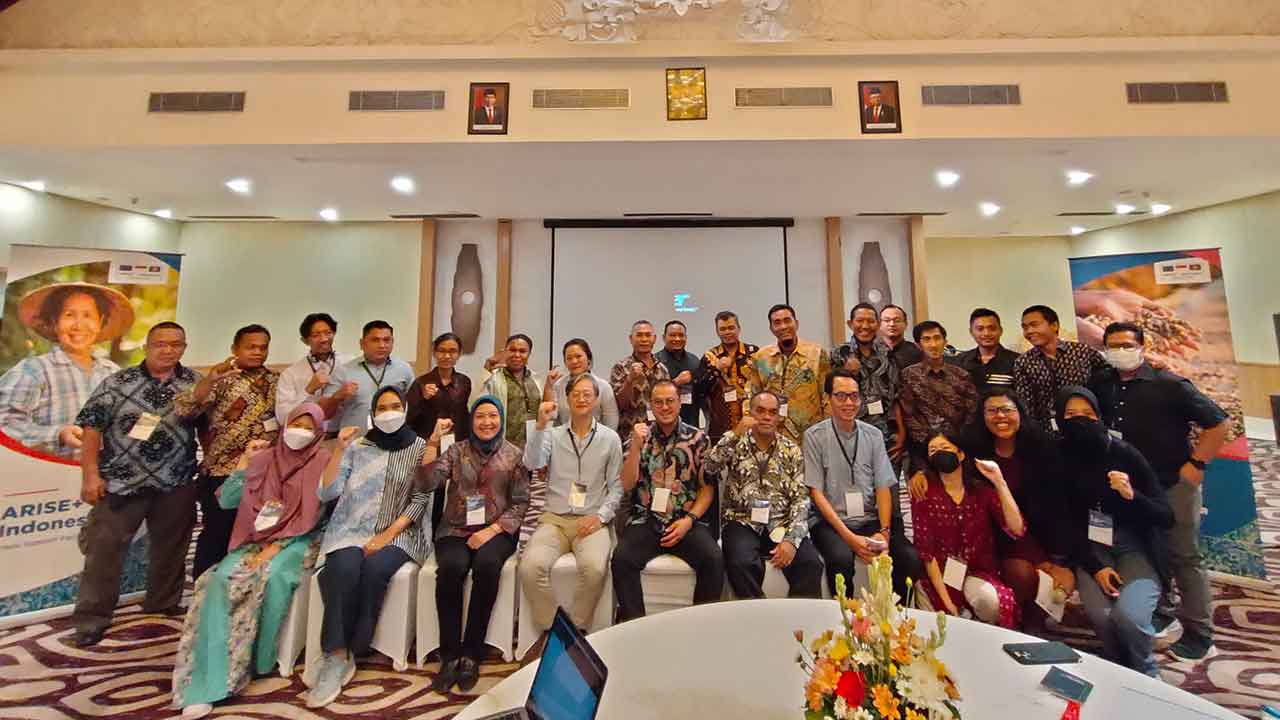
Ten selected Geographical Indication Rights Holder Communities (MPIGs) completed their first Enhancement Programme (EP) Training in Bali, 18-22 July 2022, facilitated by ARISE+ Indonesia under the auspices of the Directorate General of Intellectual Property (DGIP) of the Ministry of Law and Human Rights, the Directorate General of National Export Development (DGNED) of the Ministry of Trade, and the Directorate of Intellectual Property Development of the Ministry of Tourism and Creative Economy.
The training responds to the MPIGs' needs to strengthen their institutional capacity, with a focus on product branding, market positioning and expanding distribution networks. Based on a needs assessment conducted prior to the start of the training, it was found that many MPIGs are still facing challenges in introducing their product as Geographical Indication products to consumers.
Speaking at the opening ceremony, the Coordinator of Foreign Cooperation in the DGIP, Fajar Sulaeman, advised MPIGs to always be committed to protecting their GI product reputation by maintaining the quality while promoting and expanding the market. He also encouraged MPIGs to establish connections among themselves.
EP is expected to also serve as a platform for MPIGs cooperation, peer-to-peer capacity building and best practices exchanges.
The Ministry of Trade, represented by Merry Astrid Indriasari, Senior Trade Analyst at the DGNED, reiterated its commitment to support MPIGs in promoting and accessing domestic and international markets. However, she recommended that MPIGs needed to enhance their readiness to meet the requirements and standards of export markets. She also praised the excellent cooperation built among the ministries through ARISE+ Indonesia activities and called for enhanced coordination with other line ministries to support MPIGs.
In her remarks, the Sub-coordinator of Intellectual Property Registration Facilitation, the Directorate of Intellectual Property Development of the Ministry of Tourism and Creative Economy, Ajeng Riananda, showed opportunities to expand the GI business in Ecotourism and encouraged MPIGs to do so and invited MPIGs for further collaboration. She also commended ARISE+ Indonesia for excellent support and activity in developing Indonesian GI.
ARISE+ Indonesia Team Leader, Marc Kwai Pun, appreciated the ministries' commitment to supporting MPIG and said that this EP training is also expected to be a networking forum between MPIGs and the central and regional governments for further enhancement in the future.
The Enhancement Programme was designed into two training sets and a mini-project assignment. The first training focused on the following themes in an interactive setting: leadership and organisational management, business roadmap development, branding and marketing strategy, internal and external control systems, certification, amendments to the Description Document, and traceability. Sharing lessons sessions featuring MPIGs Muntok White Pepper and Berau Cacao on internal and external control systems and MPIG Bali Amed Salt on traceability were also organised. At the end of the first training, the participants were given an assignment to prepare a product presentation and sample with proper labels and attractive packaging for the second training.
The second training will take place on 22-26 August in Bali, focusing on promoting business partnerships with the private sector. During this session, the participants will present their products to potential business partners and aim at leveraging on product differentiation.
According to ARISE+ Indonesia GI Senior Expert Giovanni Galanti, the EP would not only provide valuable tools for strengthening the MPIG organisation but also build their confidence to improve their bargaining position to promote their GI products with proper branding and label.
"Selling the GI product with proper branding and label is very important," Galanti said.
The EP also introduced emerging cross-cutting priorities in the GI sector and trends in consumer attitudes that can be leveraged. The cross-cutting priorities include Green deals and an eco-friendly approach to the value chain (e.g. preventing deforestation), a circular economy to minimise externalities and waste along value chains, and the From Farm to Fork approach, which strengthens control and traceability of GI value chains.
"We need to pay attention to these issues, but at the same time, we can also leverage these trends to build a narrative for the product and improve added value." Galanti said.
With the knowledge acquired through the training on organisational management and business development , MPIGs can plan their next steps and future development.
"The workshops have inspired us on what to do to develop our MPIG in the future," said Yoseph Janu, the Chairman of MPIG Flores Manggarai Arabica Coffee. "We now can devise a business strategy to make our organisation sustainable."